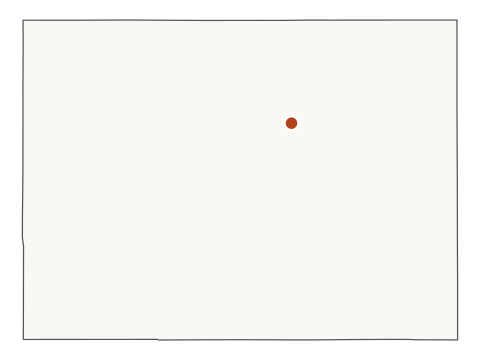
Aurora, Colorado: 410,053 residents as of July 1, 2025 (Census Vintage 2025). Ranked #50 nationally, #3 in Colorado.
SourceU.S. Census · PEP
VintageV2025
Reference2025-07-01
Place typeIncorporated place
GEOID0804000
Last build2026-05-15
At a glance.
2025 population
410,053
Census Vintage 2025
Median HH income
$88,368
+13.7% vs US $77,719
Median home value
$469,100
+54.6% vs US $303,400
Avg July high
89°F
NOAA 1991–2020
Gigabit broadband
63%
ISP-reported, FCC BDC
Unemployment
4.3%
Aurora · BLS LAUS
Key statistics.
2025 population
410,053
Census Vintage 2025, July 1, 2025
2020 base
386,255
April 1, 2020 census base
5-yr change
+23,798
2020 base → 2025; within V2025
5-yr change %
+6.2%
Within V2025 only
1-yr change
+1,728
2024 → 2025 estimate
1-yr change %
+0.4%
Within V2025 only
Density
2,498
people per sq mi, land only
Land area
164.1
sq mi (2025 Gazetteer)
U.S. rank by population
#50
of 19,483 cities
State rank by population
#3
of 272 in Colorado
Population history.
Population grew 6.2% from the April 2020 base to mid-2025.
Vintage 2025 · annual estimates
Recent history (V2025 series, 2020 base → 2025).
2020 base: 386,255 → 2025: 410,053 (+6.2%)
Year
Population
Reference date
2020 base
386,255
April 1, 2020
2020
386,688
July 1, 2020
2021
390,508
July 1, 2021
2022
394,724
July 1, 2022
2023
399,712
July 1, 2023
2024
408,325
July 1, 2024
2025
410,053
July 1, 2025
Earlier history (2010–2019, prior Census vintage)
These figures come from the U.S. Census Bureau’s Vintage 2019 release — a separate, earlier methodology. They’re shown here as historical context only; the 2010 and 2019 values aren’t directly comparable to the 2020–2025 series above.
Population grew 16.8% from 2010 to 2019 (V2019 — see seam note below).
2010 base: 324,659 → 2019: 379,289 (+16.3%)
Year
Population
Reference date
2010 base
324,659
April 1, 2010
2010
326,055
July 1, 2010
2011
332,730
July 1, 2011
2012
339,261
July 1, 2012
2013
345,613
July 1, 2013
2014
352,660
July 1, 2014
2015
360,098
July 1, 2015
2016
363,277
July 1, 2016
2017
367,574
July 1, 2017
2018
374,572
July 1, 2018
2019
379,289
July 1, 2019
Income & poverty.
Median household income is 14% above the U.S. median ($88,368 vs $77,719); 11.9% live in poverty — 0.6 points below the 12.5% U.S. rate.
Income and poverty estimates for Aurora from the U.S. Census Bureau's American Community Survey (ACS) 5-Year estimates (window 2020–2024). Every figure is shown with its 90% margin of error (MOE). Cells where the ± margin exceeds half the estimate are flagged "low precision." See methodology §12.
Measure
Estimate
± margin / note
Median household income
88,368+13.7% vs US
±2,017
Per capita income
42,105-2.7% vs US
±854
Population in poverty
11.9%
share of population for whom poverty status is determined
Median home value is 55% above the U.S. median ($469,100 vs $303,400); median rent is 36% above ($1,835 vs $1,348); price-to-income ratio is 5.3×, making it 1.4× as cost-burdened as the typical U.S. city (3.9×).
Owner-occupied home values, renter costs, and tenure split from the ACS 5-Year (2020–2024). All figures inflation-adjusted to 2024 dollars by Census.
Measure
Estimate
± margin / note
Median value, owner-occupied units
469,100+54.6% vs US
±3,518
Median gross rent
1,835+36.1% vs US
±26
Owner-occupied share
62.4%
of occupied housing units
Price-to-income ratio
5.3x+36.0% vs US
median home value ÷ median household income · U.S. median: 3.9x
Poverty (Census SAIPE 2024, model-based), unemployment (BLS LAUS 2024 annual averages), and remote-work share (ACS 2020–2024) for Aurora. Numbers are labeled at their native grain — place-grain when BLS publishes it, otherwise per-county. We do not compute population-weighted county averages. See methodology §13.
Measure
Value
Grain
Unemployment rate (annual avg)
4.3%
Aurora (BLS sub-state LAUS)
Civilian labor force
221,491
2024 annual avg
Worked from home
16.5%+17.5% vs US
share of workers 16+ commuting from home · U.S. median: 14% · ACS
County context — Aurora spans 3 counties; all are listed (no weighted average):
County
Poverty rate
Median HH income
Unemployment
Adams County
9.8%
$100,686
4.5%
Arapahoe County
7.8%
$103,442
4.2%
Douglas County
4.3%
$152,657
3.9%
Top industries by private employment — NAICS supersectors rolled up from Aurora's linked 3 counties in the U.S. Bureau of Labor Statistics' Quarterly Census of Employment and Wages (QCEW, 2024 annual averages). See methodology §11.
22.4% foreign-born (U.S. median 14%); Spanish is the most-spoken language at home other than English (21.0% of residents 5+).
Where Aurora's residents come from and what they speak at home, from the ACS 5-Year 2020–2024. Foreign-born is the share of residents born outside the U.S. (any citizenship status); language-at-home is reported only for residents 5 and older.
Measure
Value
± margin / note
Foreign-born share
22.4%+59.8% vs US
share of residents born outside the U.S. · U.S. median: 14% · ACS B05002
Speak only English at home
66.9%
share of population 5+ · ACS C16001 line 2
Top non-English language at home
Spanish21.0%
most-spoken language other than English among residents 5+ · ACS C16001 collapsed buckets
These are K-12 public school districts. Higher education (colleges and universities) is not represented in this dataset.
Public school districts serving Aurora, from the NCES EDGE Geographic Relationship Files (GRF25, 2024–25 school year boundaries). The join is many-to-many — large cities often span multiple districts, and one district often serves multiple cities. Sorted primary district first. See methodology §12 for the consolidated-city fallback and Milford CT special case.
Source: NCES EDGE GRF25 · school year 2024–25 · methodology →
Climate.
Hottest month: July (89°F avg high). Coldest: December (18°F avg low). Annual precipitation: 15.4 in.
30-year climate normals (1991-2020) for Aurora from the U.S. National Oceanic and Atmospheric Administration. See methodology §15 for the gridded vs. station source path.
Average monthly highs & lows · 30-year normal (NOAA 1991–2020). Every number on this chart is an average.
bar = avg daily high → avg daily lowprecip in inches below each barprecip in millimeters below each bar
Composite risk spans 88.7–93.8/100 across 3 counties; most-cited top hazard is Hail (in 2 of 3).
Natural-hazard exposure for Aurora from the U.S. Federal Emergency Management Agency's National Risk Index (FEMA NRI March 2023). NRI is an expected-annual-loss composite calibrated on 1996–2019 historical losses, published at the U.S. county grain. See methodology §17.
Aurora spans 3 counties. We list each separately because hurricane, flood, and fire risk varies meaningfully across county lines — manufacturing a single “city-level” risk score would hide that signal.
County
NRI composite
Rating
Top hazards
Adams County
91.2
Relatively Moderate
Hail · score 99.7 · Very High
Winter Weather · score 97.4 · Very High
Cold Wave · score 97.2 · Relatively High
Arapahoe County
93.8
Relatively Moderate
Hail · score 99.8 · Very High
Lightning · score 98.4 · Very High
Tornado · score 97.2 · Relatively High
Douglas County
88.7
Relatively Moderate
Lightning · score 99.3 · Very High
Hail · score 98.6 · Relatively High
Wildfire · score 98.4 · Relatively High
Source: FEMA National Risk Index · FEMA NRI March 2023 · methodology →
Internet & broadband.
20 non-satellite ISPs serve the area; 63% of locations have gigabit-capable service per ISP filings.
Fixed broadband availability for Aurora from the U.S. Federal Communications Commission's Broadband Data Collection (BDC), as of June 30, 2025. Every speed and provider count below is an ISP-reported advertised maximum — not measured throughput. Actual delivered speeds typically run 60–80% of advertised. See methodology §16.
Measure
Value
Note
Providers serving this city
20 + satellite
distinct ISPs, excluding satellite-only
Fiber providers
14
offer fiber-to-the-premises somewhere in the BDC
Units with ≥100/20 Mbps fixed
100.0%
share of broadband-serviceable units, ISP-reported max
Locations with ≥100 Mbps upload
63.4%
derived: max(fiber ≥100/20, gigabit). Fiber is symmetric; gigabit is ≥100 up by definition
Units with ≥1 Gbps fixed
63.4%
share of broadband-serviceable units, ISP-reported max
Total broadband-serviceable units
171,714
residential locations in the FCC Fabric (not households)
Source: FCC BDC · as of June 30, 2025 · methodology →
In-state context.
Aurora sits at state rank #3 among 272 cities in Colorado. Nearby in the state ranking:
Aurora is ranked #50 of 19,483 U.S. cities by 2025 population.
Just above in the profiled set: Tampa, FL · #49 · 413,554 residents.
Quick travel facts for Aurora
Quick travel facts.
Nearest commercial airport
Denver International Airport(DEN) ·
11 mi 17 km from city centroid
Best months to visit
Oct · months when the avg high sits in 65–80°F and precipitation is at or below the city's median monthly precip
Sources: elevation from USGS Elevation Point Query Service (3DEP) · nearest airport from OurAirports CSV (FAA-aligned, type=large/medium, scheduled_service=yes) · best months derived from NOAA 1991-2020 normals · methodology →
Sources · provenance
Every number on this page traces to a federal dataset.
The GEOID for Aurora is 0804000. Each row below is one upstream dataset surfaced on this page; click "methodology" for inclusion rules and the V2019 ↔ V2025 seam, or "source" for the raw publisher page.