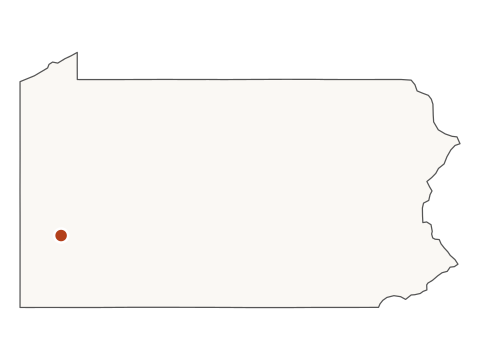
Latest Census city estimates released May 14, 2026 · Population as of July 1, 2025 · Next city estimates scheduled for May 2027. Release schedule
Pittsburgh, Pennsylvania population is 307,632 as of July 1, 2025 (U.S. Census Bureau Vintage 2025 estimate), ranking #68 nationally and #2 in Pennsylvania. Cost of living runs 5.3% below the U.S. average (BEA RPP 2024). This profile draws on 13 federal datasets covering population, housing, income, employment, climate, and risk.
307,632 people live in Pittsburgh as of July 1, 2025 (U.S. Census Bureau Population Estimates Program, Vintage 2025), the #68 largest U.S. city.
How big is Pittsburgh?
Pittsburgh covers 55.4 square miles of land and 3.0 square miles of water. Its population density is about 5,556 residents per square mile of land. Compare U.S. cities by land area →
Source detail: 2025 population
2025 population
Source agency
U.S. Census Bureau, Population Division
Dataset
Census PEP
Vintage / period
Vintage 2025 (Jul 1, 2025)
Native geography
Census PEP subcounty place records for the included city universe.
Transformation
Copied from POPESTIMATE2025, joined by Census GEOID, and used for ranks, filters, and city pages.
Known limit: Annual estimate, not a decennial count; each new PEP vintage can revise the prior series.
Population grew 1.5% from the April 2020 base to mid-2025.
Vintage 2025 · annual estimates
Recent history (V2025 series, 2020 base → 2025).
2020 base: 303,054 → 2025: 307,632 (+1.5%)
Year
Population
Reference date
2020 base
303,054
April 1, 2020
2020
302,859
July 1, 2020
2021
305,343
July 1, 2021
2022
303,012
July 1, 2022
2023
304,508
July 1, 2023
2024
306,719
July 1, 2024
2025
307,632
July 1, 2025
Earlier history (2010–2019, prior Census vintage)
These figures come from the U.S. Census Bureau’s Vintage 2019 release — a separate, earlier methodology. They’re shown here as historical context only; the 2010 and 2019 values aren’t directly comparable to the 2020–2025 series above.
Population shrank 1.6% from the July 2010 estimate to 2019 (V2019 — see seam note below).
Pittsburgh is the #68 largest of 19,483 U.S. cities and #2 in Pennsylvania.
▸Show the analyst detail (9 rows)
Measure
Value
Note
2020 base
303,054
April 1, 2020 census base
5-yr change
+4,578
2020 base → 2025; within V2025
5-yr change %
+1.5%
within V2025 only
1-yr change
+913
2024 → 2025 estimate
1-yr change %
+0.3%
within V2025 only
Density
5,556
people per sq mi, land only
Land area
55.4
sq mi (2025 Gazetteer)
U.S. rank by population
#68
of 19,483 cities
State rank by population
#2
of 1,014 in Pennsylvania
What is the median household income in Pittsburgh?
Same-period U.S. benchmarks: household income $80,734 ± $166; per-capita income $44,673 ± $122. Margins are at 90% confidence. Comparison badges describe point estimates; they are not significance tests.
Median household income is 19% below the U.S. median ($65,742 vs $80,734); 20.1% live in poverty, 7.6 points above the 12.5% U.S. estimate.
Median household income$65,742
US
Pittsburgh: $65,742 — 19% below the US median of $80,734.
Scale: 10th–90th percentile of cities with ACS income data; censored rows retained in the distribution
Pittsburgh
$65,742
United States
$80,734
Income and poverty estimates for Pittsburgh from the U.S. Census Bureau's American Community Survey (ACS) 5-Year estimates (window 2020–2024). Every figure is shown with its 90% margin of error (MOE). Cells where the ± margin exceeds half the estimate are flagged "low precision." See methodology §12.
Measure
Estimate
± margin / note
Median household income
$65,742-18.6% vs US
±$1,484
Per capita income
$45,385+1.6% vs US
±$1,102
Population in poverty
20.1% ± 0.9 percentage points
share of population for whom poverty status is determined
Median home value is 38% below the U.S. median ($205,800 vs $332,700); median rent is 11% below ($1,261 vs $1,413); the ratio of median home value to median household income is 3.1× versus 4.1× nationally; this compares two distributions and does not measure an individual household's housing burden.
Median home value$205,800
US
Pittsburgh: $205,800 — 38% below the US median of $332,700.
Scale: 10th–90th percentile of cities with ACS home-value data; censored rows retained in the distribution
HUD 2-BR fair-market rent$1,299/mo
US
Pittsburgh: $1,299/mo — 21% above the US median of $1,077/mo.
Scale: 10th–90th percentile of cities with a HUD Fair Market Rent
Same-period U.S. benchmarks: home value $332,700 ± $236; gross rent $1,413 ± $2. Comparison badges describe estimates and do not establish statistical significance.
Measure
Estimate
± margin / note
Median value, owner-occupied units
$205,800-38.1% vs US
±$5,061
Median gross rent
$1,261-10.8% vs US
±$27
HUD Fair Market Rent, 2-BR (FY2026)
$1,299-2.9% vs US
Pittsburgh, PA HUD Metro FMR Area· 40th-percentile gross rent · HUD methodology
Owner-occupied share
47.7% ± 0.8 percentage points
of occupied housing units
Price-to-income ratio
3.1x± 0.10x approximate 90% MOE-24.0% vs US
median home value ÷ median household income · U.S. ratio: 4.1x
Rent-burdened (≥30% of income)
48.4% ± 1.9 percentage points-5.2% vs US
renters with a computed rent/income ratio · U.S. share: 51.1%
Severely rent-burdened (≥50%)
25.2% ± 1.4 percentage points-2.7% vs US
renters with a computed rent/income ratio · U.S. share: 25.9%
Poverty (Census SAIPE 2024, model-based), unemployment (BLS LAUS 2025 annual averages), and remote-work share (ACS 2020–2024) for Pittsburgh. Numbers are labeled at their native grain — place-grain when BLS publishes it, otherwise per-county. We do not compute population-weighted county averages. See methodology §13.
Measure
Value
Grain
Unemployment rate (annual avg)
3.6%
Pittsburgh (BLS sub-state LAUS)
Civilian labor force
164,603
2025 annual avg
Worked from home
22.4% ± 0.9 percentage points+48.0% vs US
share of workers 16+ working from home · U.S. share: 15.1% · ACS
County context — Pittsburgh sits in Allegheny County:
County
Poverty rate
Median HH income
Unemployment
Allegheny County
11.7%
$80,878
4.0%
Top industries by private employment — NAICS supersectors rolled up from Pittsburgh's linked county in the U.S. Bureau of Labor Statistics' Quarterly Census of Employment and Wages (QCEW, 2025 annual averages). See methodology §11.
#
Industry (NAICS supersector)
Private employment
Avg weekly wage
#1
Health care and social assistance (62)
135,706
$1,393 / wk
#2
Retail trade (44-45)
61,288
$804 / wk
#3
Accommodation and food services (72)
58,064
$550 / wk
#4
Professional and technical services (54)
56,982
$2,511 / wk
#5
Finance and insurance (52)
38,883
$2,500 / wk
What workers earn in the Pittsburgh, PA metro — top occupations by employment plus six curated benchmarks (registered nurse, software developer, elementary teacher, general manager, retail salesperson, truck driver). Wages are metro-area medians from the U.S. Bureau of Labor Statistics' Occupational Employment and Wage Statistics (May 2025). See methodology §25.
Home Health and Personal Care Aides is the largest tracked occupation in the Pittsburgh, PA metro (37,200 jobs, median $29,250/yr).
▸Show all 13 occupations
Occupation
Employment
Median annual
Median hourly
Home Health and Personal Care Aides
37,200
$29,250
$14.06
Fast Food and Counter Workers
27,460
$28,250
$13.58
Cashiers
20,950
$29,470
$14.17
Office Clerks, General
19,150
$45,040
$21.65
Laborers and Freight, Stock, and Material Movers, Hand
18,830
$41,830
$20.11
Stockers and Order Fillers
18,060
$35,900
$17.26
Customer Service Representatives
17,280
$42,790
$20.57
General and Operations Managers · benchmark
31,020
$100,840
$48.48
Registered Nurses · benchmark
29,360
$82,370
$39.60
Retail Salespersons · benchmark
28,700
$30,840
$14.83
Heavy and Tractor-Trailer Truck Drivers · benchmark
14,620
$57,880
$27.83
Software Developers · benchmark
10,320
$124,500
$59.85
Elementary School Teachers, Except Special Education · benchmark
All items run 5.3% below the U.S. average (RPP 94.7); rents run 28.0% below (RPP 72.0) — the metro's housing affordability is the main driver.
Cost of living (RPP, all items)RPP 94.7
US
Pittsburgh's cost of living runs 5.3% below the U.S. average (RPP 94.7 vs 100).
Scale: 10th–90th percentile of metro/non-metro areas with a BEA price parity
BEA Regional Price Parity (all items)
RPP 94.7
−5.3% vs U.S. average · BEA 2024 · Pittsburgh, PA metro
HUD Fair Market Rent, 2-BR
$1,299/mo
FY2026 · Pittsburgh, PA HUD Metro FMR Area
State income tax (top marginal rate)
3.07%
flat · TY2026
One-person monthly spending scenario
$3,276/mo
1BR rent + food + taxes + transport · federal sources; excludes unverified local income tax
Local income tax
—
Unverified and excluded from the spending scenario; not a verified zero
Household budget figures are arithmetic floors using current federal sources at the grains documented in methodology. Not a recommended salary, not a poverty threshold, not a composite score.
9.5% ± 0.6 percentage points foreign-born (U.S. share 14.1%); Spanish is the most-spoken language at home other than English (3.0% of residents 5+).
A quick read on Pittsburgh's residents — nativity and languages spoken at home shown above, from the ACS 5-Year 2020–2024. The full demographic breakdown (age, race and ethnicity, household types, and educational attainment, each with its margin of error) lives on the demographics page.
These are K-12 public school districts. Higher education (colleges and universities) is not represented in this dataset.
Public school districts serving Pittsburgh, from the NCES EDGE Geographic Relationship Files (GRF25, 2024–25 school year boundaries). The join is many-to-many — large cities often span multiple districts, and one district often serves multiple cities. Sorted primary district first. See methodology §12 for the consolidated-city fallback and Milford CT special case.
Source: NCES EDGE GRF25 · school year 2024–25 · methodology →
What is the climate like in Pittsburgh?
Hottest month: July (85°F avg high). Coldest: January (22°F avg low). Annual precipitation: 40.0 in.
30-year climate normals (1991-2020) for Pittsburgh from the U.S. National Oceanic and Atmospheric Administration. See methodology §15 for the gridded vs. station source path.
Average monthly highs & lows · 30-year normal (NOAA 1991–2020). Every number on this chart is an average.
bar = avg daily high → avg daily lowprecip in inches below each barprecip in millimeters below each bar
Composite risk score: 98.1/100 — Relatively High nationally; top hazard: Riverine Flooding (99.2).
Natural-hazard exposure for Pittsburgh from the U.S. Federal Emergency Management Agency's National Risk Index (FEMA NRI December 2025 v1.20.0). NRI is an expected-annual-loss composite calibrated on 1996–2019 historical losses, published at the U.S. county grain. See methodology §17.
County
NRI composite
Rating
Top hazards
Allegheny County
98.1
Relatively High
Riverine Flooding 99.2 Very High · Cold Wave 98.8 Very High · Strong Wind 96.3 Relatively High
Source: FEMA National Risk Index · FEMA NRI December 2025 v1.20.0 · methodology →
How fast is home internet in Pittsburgh?
15 non-satellite ISPs serve the area; 99% of locations have gigabit-capable service per ISP filings.
Fixed broadband availability for Pittsburgh from the U.S. Federal Communications Commission's Broadband Data Collection (BDC), as of December 31, 2025. Every speed and provider count below is an ISP-reported advertised maximum — not measured throughput. Actual delivered speeds typically run 60–80% of advertised. See methodology §16.
Measure
Value
Note
Providers serving this city
15 + satellite
distinct ISPs, excluding satellite-only
Fiber providers
13
offer fiber-to-the-premises somewhere in the BDC
Units with ≥100/20 Mbps fixed
100.0%
share of broadband-serviceable units, ISP-reported max
Locations with ≥100 Mbps upload
99.3%
derived: max(fiber ≥100/20, gigabit). Fiber is symmetric; gigabit is ≥100 up by definition
Units with ≥1 Gbps fixed
99.3%
share of broadband-serviceable units, ISP-reported max
Total broadband-serviceable units
174,297
residential locations in the FCC Fabric (not households)
Source: FCC BDC · as of December 31, 2025 · methodology →
How much crime is reported in Pittsburgh?
In 2024, law enforcement reported 1,355 violent and 7,232 property offenses in the Pittsburgh jurisdiction — a violent-crime rate of 427.2 per 100,000, above the U.S. estimate of 359.1.
Reported offenses known to law enforcement from the FBI Uniform Crime Reporting Program (CIUS Table 8), 2024. Figures describe the FBI agency jurisdiction: Pittsburgh — an FBI jurisdiction population of 317,177, versus the Census place population of 307,632. The rate per 100,000 is the FBI's own (count ÷ that jurisdiction population), never divided by the Census place figure. These are reported crimes under voluntary participation — not measured or victimization crime — and the FBI cautions against using them to rank or compare places. See methodology §31.
Offenses known, 2024
Count
Rate /100k
U.S. rate
Violent crime
1,355
427.2
359.1
Property crime
7,232
2,280.1
1,760.1
▸Offense breakdown and 1-year trend
Offense, 2024
Count
Murder and nonnegligent manslaughter
36
Rape
164
Robbery
394
Aggravated assault
761
Burglary
738
Larceny-theft
5,406
Motor vehicle theft
1,088
Arson (12-month reporters only)
72
Only years the agency reported a complete 12 months appear; the FBI does not estimate missing agency-years, so a gap is a non-reporting year, not zero crime.
U.S. rate is the FBI national estimate (imputes non-reporting agencies); the city figures are reported-only. Source: FBI UCR CIUS Table 8 (2024–2024) · FBI agency jurisdiction: Pittsburgh · methodology → · FBI Crime Data Explorer →
In-state context.
Pittsburgh sits at state rank #2 among 1,014 cities in Pennsylvania. Nearby in the state ranking:
Just above in the profiled set: Greensboro, NC · #67 · 308,667 residents.
Just below in the profiled set: St. Paul, MN · #69 · 306,684 residents.
Quick travel facts for Pittsburgh
Quick travel facts.
Elevation
969 ft · at city centroid, from USGS 3D Elevation Program
Nearest scheduled-service airport
Pittsburgh International Airport(PIT) · 14 mi 23 km from city centroid
Best months to visit
Oct · months when the avg high sits in 65–80°F and precipitation is at or below the city's median monthly precip
Sources: elevation from USGS 3DEP · nearest airport from OurAirports CSV (OurAirports type=large/medium and scheduled_service=yes; not an FAA service classification) · best months derived from NOAA 1991-2020 normals · methodology →
Frequently asked questions about Pittsburgh.
How many people live in Pittsburgh, PA?
Pittsburgh has 307,632 residents as of July 1, 2025, making it the #68 largest city in the United States and #2 in Pennsylvania. Source: U.S. Census Bureau Population Estimates Program, Vintage 2025.
Is Pittsburgh growing or shrinking?
Pittsburgh has grown 1.5% since the April 2020 census baseline, adding 4,578 residents, including a 0.3% increase from 2024 to 2025. Source: Census PEP Vintage 2025.
What was Pittsburgh's population in the 2020 census?
Pittsburgh covers 55.4 square miles of land, with a population density of about 5,556 residents per square mile. Source: Census Gazetteer 2025.
What is the median household income in Pittsburgh?
$65,742, about 19% below the U.S. median. Source: ACS 5-year estimates, 2020–2024.
SourceU.S. Census · PEP
VintageV2025
Reference2025-07-01
Place typeIncorporated place
GEOID4261000
Last build2026-09-30
Sources · provenance
Every listed dataset is used on this page.
The GEOID for Pittsburgh is 4261000. These are the official datasets used by this profile's main data modules; click "methodology" for inclusion rules and the V2019 ↔ V2025 seam, or "source" for the raw publisher page. The headline population value above includes a source-detail disclosure with publisher, dataset, vintage, native geography, transformation, and caveat.